Using Fable 5 as an Advisor and Orchestrator
Exploring two main scenarios for using Fable 5: as an advisor and as an orchestrator, optimizing costs and enhancing efficiency.
Using Fable 5 as an Advisor
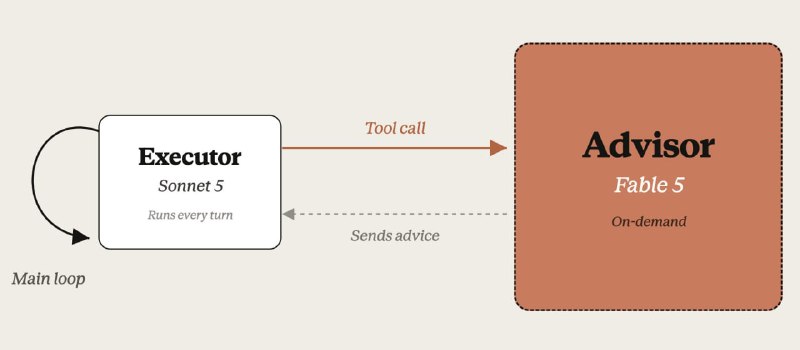
In this scenario, Sonnet 5 acts as the executor and consults Fable 5 for recommendations.
Most of the tokens are billed at a lower executor rate.
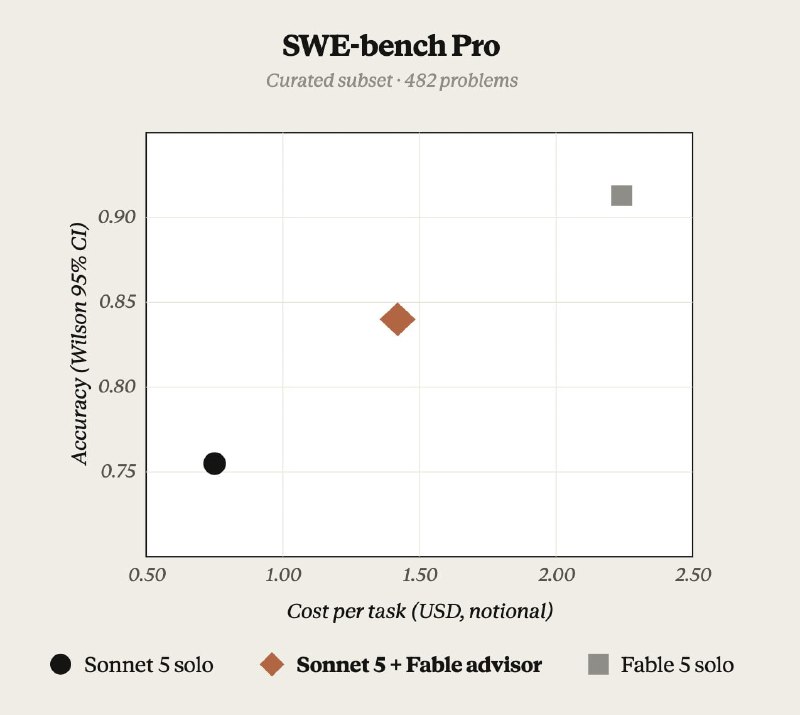
On the SWE-bench Pro benchmark, the Sonnet 5 + Fable 5 combination as an Advisor achieves about 92% of Fable 5's quality, while the cost is approximately 63% of using a single Fable 5.
With this approach, Fable 5 is called infrequently (about once per task) to determine the strategy, while the bulk of the work is performed by Sonnet 5.
More details in the documentation.
Using Fable 5 as an Orchestrator
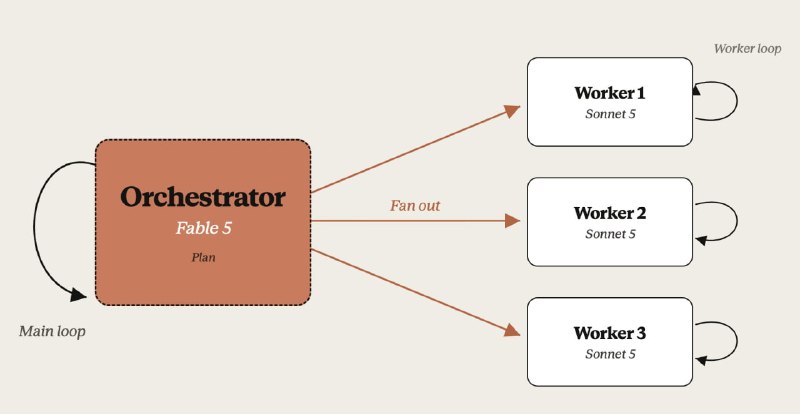
In this case, Fable 5 plans the execution of the task and distributes it among executors (Sonnet 5).
Most of the tokens are billed at a lower executor rate.
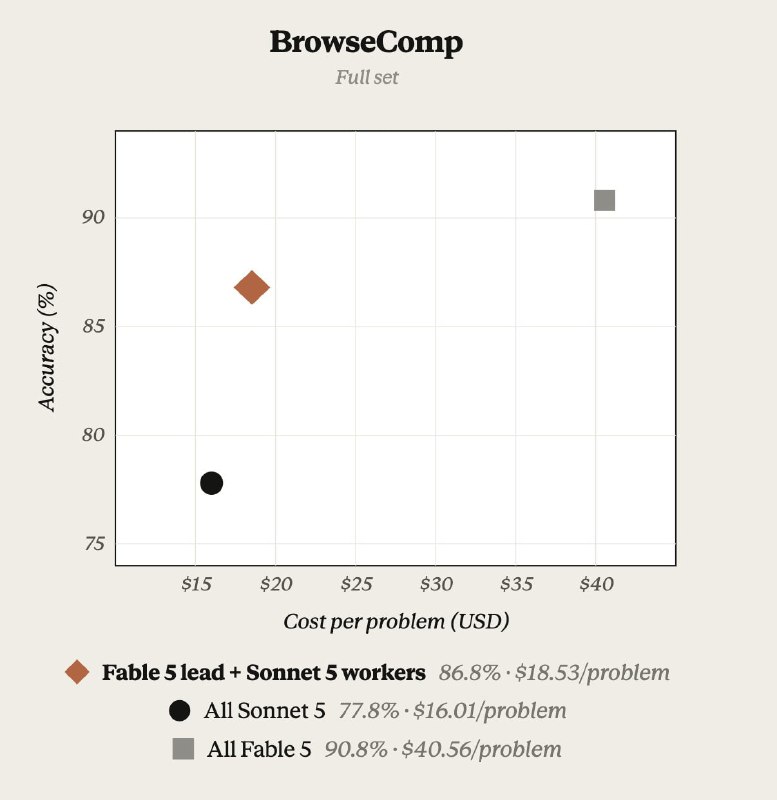
In BrowseComp tests, Claude Managed Agents were used with the Fable 5 orchestrator and Sonnet 5 subagents as executors. This configuration provides 96% of Fable 5's performance at 46% of its cost.
Resource-intensive research tasks are assigned to Sonnet 5.
More details in the example: cookbook.
P.S.
Claude Managed Agents supports both approaches.
With subagents, you can:
- delegate complex tasks to Fable 5 as an Advisor;
- assign task execution to Sonnet 5 executors.
Each subagent uses its own cache, so repeated calls do not require reprocessing the same context in full.
Why it matters
AnalysisThis is important because using Fable 5 as an advisor and orchestrator can significantly reduce data processing costs and enhance task execution efficiency. Innovative resource management approaches in AI can fundamentally change how we work with technology.
Discuss in community
Share your questions and insights with developers