New Routing Architecture for AI Models
A compact LLM router has been developed to optimize the use of AI models for various requests.
This is interesting: A developer has reverse-engineered the routing architecture underlying Skana AI Fugu and implemented an analog for open frontier models.
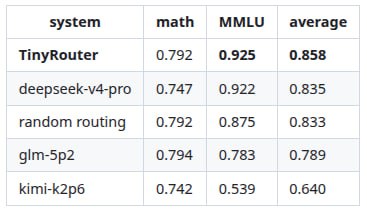
tinyrouter is a compact LLM router with approximately 10,000 parameters that learns to determine which model to use and what role it should perform for each request.
The goal was simple: to outperform each individual model by directing each task to the most suitable specialized executor, rather than relying on a single LLM.
Some interesting observations:
- Routing is beneficial only when models have complementary strengths. If all models show similar results on a single benchmark, the router has little to optimize.
- On MMLU, the router outperformed each individual model. On mathematical tasks, it achieved results on par with the best model, as the set of models demonstrated very low diversity in solution quality.
- Pre-initializing the router and tuning the reward function in evolutionary training improved the learning process. However, the authors do not yet claim a real quality gain, as the variance in results during evaluation was too high. More rigorous experiments are needed to confirm the effect.
Why it matters
AnalysisThis project showcases an innovative approach to optimizing AI models, which can significantly enhance their effectiveness. The development of new solutions in this area has the potential for substantial improvements across various applications.
Discuss in community
Share your questions and insights with developers